Tag: faith

  • But God, I Really Don’t Wanna…

    But God, I Really Don’t Wanna…

    I am sitting in the library right now (Saturday, August 8, 2026, 12:28pm) doing something I really do not want to do. And when I say I do not want to do it, I mean there is a full-blown toddler living inside of me with her arms crossed, bottom lip poked out, quietly preparing to throw herself on the floor.

    But God, I really don’t wanna...

    That is about as sophisticated as my prayer has been lately. Here is the context…

    I recently entered the world of academia, and if I am being completely truthful, academia was always part of my nursing plan. Just not this current plan. In my mind, I would settle into the executive leadership phase of my career first. I would spend more years refining my ability to lead teams, build programs, influence systems, and do the work I have spent so much of my career preparing to do. Then, somewhere later down the road, I would ease into academia. You know, cruise a little…

    Teach.

    Pour into the next generation.

    Maybe wear a cute cardigan and carry an unnecessarily large coffee mug while telling nursing students stories about “back when I was at the bedside.”

    That was the plan.

    The problem is that August marks one year since I have held a full-time nursing leadership position. An entire year (deep sigh). There have been conversations. Interviews. Possibilities. Opportunities that seemed promising. Doors I thought might open.

    And yet, here I am.

    I am incredibly grateful for the faculty role God provided. It came at a time when I needed it, and there is no question that teaching has awakened something in my soul. I love watching students make connections. I love helping them move from memorizing information to actually thinking like nurses. It’s humbling; having the privilege to shape nurses before the habits of the profession fully settle in.

    It is meaningful work.

    However, I was not prepared for academia to potentially become my main work right now.

    Back in April, someone in one of my church classes encouraged me to write down my plan and submit it to God. So I did. I wrote down what I wanted, what I believed the next season should look like, where I hoped my career was headed, and how was going to actively participate in the process.

    Then I waited.

    And waited.

    And, if I’m being 100% transparent with you, I became increasingly irritated with the waiting. (Need to work on that long-suffering fruit). Nothing seemed to move. Eventually, I decided maybe I needed to call an audible on my plan. About a month ago, I made a new commitment: If nothing transpired in leadership by the end of July, I would begin applying for full-time academic positions.

    Well…July has come and gone.

    Which explains why I am sitting in this library…Looking at faculty positions. Moving in a direction while everything inside of me is screaming…Noooooooo!!!!!

    Because somewhere in my mind, accepting a full-time academic position feels like closing the door on leadership. And that hurts. I have worked hard for that dream.

    Degrees.

    Certifications.

    Long days.

    Late nights.

    Difficult personalities.

    Professional development.

    Sacrifices unseen.

    I did not accidentally wander toward executive nursing leadership. I made a choice and have intentionally built toward it for years. So, this does not feel like simply applying for another job.

    It feels like surrendering something. And maybe that is exactly why this is so uncomfortable.

    Proverbs 16:9 (NIV) says, “In their hearts humans plan their course, but the LORD establishes their steps”.

    Sadly, I like that verse much better when His steps look like my plan.

    Surrender sounds beautiful until God starts touching the things you were certain He gave you permission to desire. We talk often about trusting God with our future, but sometimes trust looks less like peaceful worship music playing in the background and more like clicking “submit application” while muttering, “Lord…I am doing this because I said I would.”

    There is something ridiculously childlike about it. And maybe there should be…

    Because He is my Father.

    A loving Father does not always allow His children to choose the route simply because it is the route they prefer. Sometimes He redirects. Sometimes He delays. Sometimes He allows us to walk into seasons we would never have selected because He can see what we cannot.

    Romans 8:28 reminds us that God works all things together for the good of those who love Him and are called according to His purpose.

    All things.

    Apparently, that includes career detours…

    Unanswered prayers…

    Unexpected classrooms…

    And plans that make us pout. ☹

    I’m thinking about Abraham, who was told to leave what was familiar without being given every detail about where he was going.

    Hebrews 11:8 (NIV) says of Abraham, “when called to go to a place he would later receive as his inheritance, obeyed and went, even though he did not know where he was going”.

    I would personally prefer a map.

    Actually, as a first daughter and eldest of seven, I would prefer a map, estimated arrival time, salary range, organizational chart, and written confirmation that executive leadership is still somewhere on the itinerary.

    God has provided none of those.

    But He has given me enough light for the next step. And right now, the next step appears to be obedience.

    Not certainty.

    Not excitement.

    Not even agreement.

    Obedience.

    Ooooh wee…I can hear Priscilla Shirer in my head right now, “Lord, show me the next twenty years! And He’s like, if I can get you to be obedient for the next twenty minutes, you’ll be exactly where you need to be.”

    Perhaps I am looking at this season incorrectly. I am treating academia like a door that, once entered, locks behind me. But what if it is a hallway? What if the leadership I have been asking God for does not disappear here, but develops differently here? What if the classroom is not the end of my leadership journey, but part of its formation?

    I do not know.

    And I am not going to tie this post up with a pretty little bow and tell you I suddenly feel wonderful about it. I don’t.

    There is still a part of me sitting here saying, “God…I really don’t wanna…”

    And perhaps the prayer does not have to become more polished than that. And underneath the whining is something deeper:

    But I trust You.

    I trust that You know what You are doing.

    I trust that the years I have spent preparing were not wasted.

    I trust that no position, title, delay, or detour can cancel what You have purposed for my life.

    And I trust that if You are redirecting me, You are not abandoning me.

    So today, I am going to do the thing I said I would do.

    Reluctantly.

    Prayerfully.

    Probably with a little attitude.

    But obediently.

    Because sometimes faith is not walking confidently toward the thing you have always wanted.

    Sometimes faith is walking toward the thing you never planned for, holding your Father’s hand and saying,

    Fine. I trust You. We’ll do this Your way. Let’s geaux.”

  • What If Jesus Went No Contact?

    What If Jesus Went No Contact?

    The other day, I came across a post on Threads from someone facing a difficult decision. They described a painful and complicated relationship with their mother—years of hurt, separation, disappointment, and attempts to navigate what appeared to be a deeply fractured bond. At some point, the person had decided that having no contact with their mother was the healthiest choice.

    Then the call came…

    A physician explained that their mother was nearing the end of her life. If they wanted an opportunity to see her, they needed to come now. As you can probably imagine, the comments were divided. Some people encouraged the person to go, even if only to say goodbye. Others insisted that a dying parent was not automatically entitled to access simply because time was running out. People shared stories of abuse, reconciliation, regret, boundaries, guilt, self-preservation, and wounds that had never fully healed.

    There were strong opinions on both sides. As I read through the discussion, the Holy Spirit placed a sobering picture in my mind:

    Imagine lying in a hospital bed, knowing your life is ending. You call out to Jesus, asking Him to forgive you…He responds with silence.

    No answer.

    No grace.

    No contact.

    The thought nearly took my breath away.

    The beautiful truth of the gospel is that those who belong to Christ never have to fear that response. We do not have to wonder whether we have finally exhausted His mercy. We do not have to question whether He has blocked us, turned away from us, or decided that our failures have become too inconvenient to forgive.

    “If we confess our sins, He is faithful and just and will forgive us our sins and purify us from all unrighteousness.”
    1 John 1:9, NIV

    Jesus does not forgive us because we deserve it. He forgives because mercy is part of who He is. We come to Him guilty, imperfect, and often carrying the consequences of choices He warned us not to make. Yet when repentance is genuine, He does not meet us with cruelty. He meets us with grace. And then He asks us to extend that grace to others.

    “Forgive as the Lord forgave you.”
    Colossians 3:13, NIV

    That is where forgiveness becomes difficult.

    It is easy to celebrate the forgiveness we receive from God. It is much harder to offer forgiveness to someone whose actions have left real wounds behind. Forgiveness does not mean pretending the pain never happened. There is no need to rewrite history or act as though the relationship has always been healthy. Forgiveness does not automatically restore trust, and it does not require someone to remain in an unsafe or destructive situation.

    Many people confuse forgiveness by equating it to relational access. God gives us 100% forgiveness (1 John 1:9) and 100% access (Hebrews 4:16). We are commanded to forgive; it is a one-person act. Boundaries (not walls) may still be necessary. Reconciliation, however, takes two. We get to decide how much access someone has to us. Distance may still be wise. Consequences may still remain. Reconciliation requires repentance, change, and honesty. Forgiveness is often the work God begins within our own hearts. It is the decision to release our right to be consumed by the offense.

    My own relationship with my father has not always been what I would have hoped. We are not completely estranged, but there have been wounds, disappointments, and distance. There are things I have had to process and grieve over the years. I have to accept that the relationship may never be what I once imagined it would be. Still, I cannot imagine knowingly allowing the end of his life to pass without being present in some way.

    Not because everything has been repaired or because the past suddenly would not matter. I would want to be present because I do not want unresolved pain to make that decision for me.

    I do not want hurt to have the final word. I want grace to have the final word. I understand everyone’s decision will look exactly like mine. Some situations are deeply complex; none of us can fully understand the weight another person carries from a brief post on social media.

    But I do believe we should be careful whenever pain begins speaking in absolutes.

    I will never forgive.

    I will never answer.

    I will never go.

    They will never receive anything from me again.

    Sometimes those statements sound like strength when they are actually evidence that the wound is still controlling us. We often think withholding forgiveness gives us power. In reality, unforgiveness can keep us emotionally tied to the very person or experience from which we are trying to become free. The relationship may have ended, but the offense continues to occupy space in our thoughts, shape our reactions, and influence our choices.

    Forgiveness does not say, what you did was acceptable. It says, what you did will not rule me forever.

    “Be kind and compassionate to one another, forgiving each other, just as in Christ God forgave you.”
    Ephesians 4:32, NIV

    Forgiveness may happen in a moment, but healing often unfolds over time. Sometimes we have to surrender the same hurt to God more than once. Sometimes forgiveness begins as an act of obedience long before our emotions catch up with the decision. We may have to pray, Lord, I want to be willing to forgive. Even when that feels impossible, we may have to pray, Lord, help me want to be willing.

    God can work with honesty. We have received mercy we could never earn, grace we could never repay, and forgiveness that does not abandon us at the moment we need it most.

    Jesus does not send a repentant heart to voicemail.

    He does not greet our confession with cold silence.

    He does not tell us that He has gone no contact.

    May we ask God to show us where pain has hardened us, where unforgiveness has quietly taken root, and where He may be inviting us to choose freedom. Not necessarily renewed access.

    Not the removal of every boundary. But freedom.

    Freedom from bitterness.

    Freedom from carrying the offense.

    Freedom to let grace have the final word.

  • Disruptions Are Not Definitions

    Disruptions Are Not Definitions

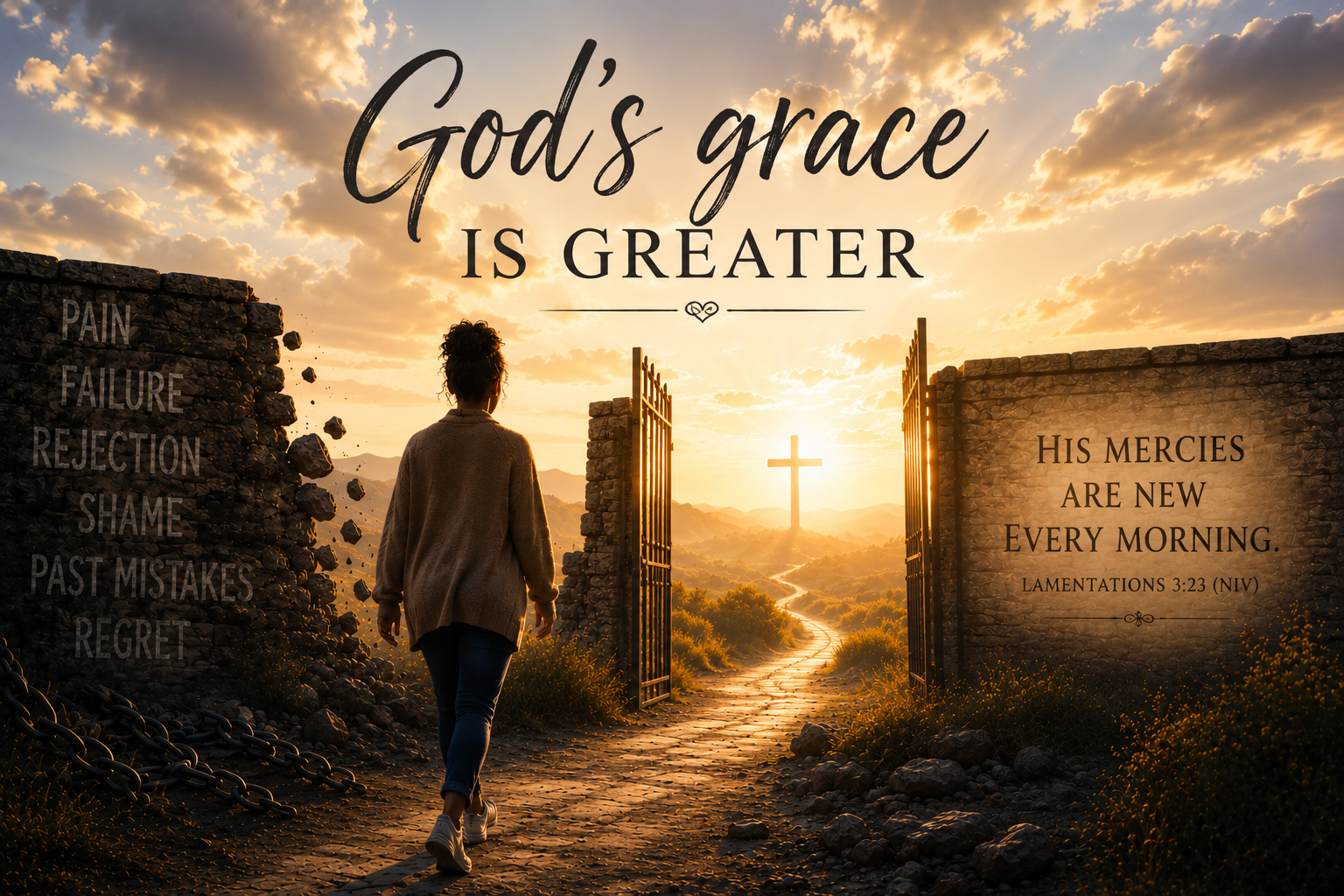
    God’s Grace Is Greater Than Your History

    My sister and I have a habit of wandering into deep conversations. We’ll start talking about something completely unrelated and somehow end up discussing the deep complexities of life. A simple question turns into an hour of unpacking experiences, perspectives, and the lessons God has been teaching us.

    Recently, we found ourselves talking about the difference between responsibility and accountability. The discussion initially centered around individuals who hold on to the past and use it as a reason for why their life is in its current state. It’s always the parent who made them pursue a career I did not desire, or the ex who tore them to shreds before leaving the relationship. Some people will even accuse God of abandoning them in their greatest time of need as a valid reason for distrust.

    To some, responsibility and accountability sound like same thing. We discussed what that looks like. If someone (regardless of intention) hands you a backpack full of bricks, you aren’t responsible for how heavy it is or who put them there. But once the backpack is on your shoulders, you become accountable for what you do next. You can continue carrying it everywhere, set it down, ask for help, or begin removing one brick at a time. The weight may not have been your fault, but your response becomes your responsibility, and the accountability of that response lies with you. In the same way, our past may explain what we’re carrying, but through Christ, we are accountable for how we choose to move forward.

    Life happens to all of us. Some people grow up in loving homes where they are encouraged, protected, and affirmed. Others grow up learning to survive. Some experienced rejection before they ever experienced acceptance. Some learned to carry responsibilities that belonged to adults long before they were old enough to understand them. Others still carry the weight of abuse, abandonment, addiction, betrayal, or words that have shaped the way they see themselves for years.

    Those experiences matter.

    They leave fingerprints on our hearts. God is not asking us to pretend they never happened.

    But there comes a point where responsibility changes hands. We may not be responsible for what happened yesterday. We are accountable for what we choose to do today. That’s a difficult truth because it removes one of the easiest places to hide. It’s far easier to point backward than it is to look inward. If we’re honest, many of us have done it…

    “I eat this way because that’s how I was raised.”

    “I struggle to trust because everyone I’ve loved has disappointed me.”

    “I don’t pursue my relationship with Jesus because I’ve never felt worthy.”

    “I can’t forgive because they never apologized.”

    While those statements may explain our reality, they don’t have to determine our future. Somewhere along the way, our explanation quietly becomes our excuse. And when that happens, we stop living as though redemption is possible.

    I love that Scripture never asks us to deny our pain.

    David didn’t. Read the Psalms and you’ll find a man who cried, questioned, grieved, feared, and wrestled with God. He didn’t hide his emotions behind polished prayers. He poured out his heart. Yet David almost always ended in the same place…He remembered who God is.

    “Why, my soul, are you downcast? Why so disturbed within me? Put your hope in God, for I will yet praise Him…” (Psalm 42:11, NIV)

    His circumstances didn’t always change immediately.

    His perspective did.

    Joseph is another great example.

    Can you imagine the temptation to spend the rest of your life blaming your brothers? They betrayed him. They stripped him of his identity. They sold him into slavery and left him for dead in every way that mattered. Joseph could have spent years saying, “This is why my life turned out the way it did.”

    Instead, after years of hardship, prison, and waiting, he looked at the very people who wounded him and said,

    “You intended to harm me, but God intended it for good to accomplish what is now being done…” (Genesis 50:20, NIV)

    Joseph didn’t rewrite history. He reinterpreted it through the faithfulness of God. His past explained him. It never excused him from becoming the man God had called him to be.

    How about the woman at the well? By every human standard, she carried enough shame to keep her hidden forever. She had a complicated past and a reputation everyone knew. Yet Jesus never defined her by the chapters everyone else had already read. Instead, He invited her into a new story. One conversation with Jesus transformed her from someone hiding at a well into someone boldly telling an entire town about the Messiah (John 4).

    That’s what grace does.

    It doesn’t erase yesterday.

    It redeems it.

    How many of us are waiting for someone else to make things right before we’re willing to move forward?

    We’re waiting on an apology.

    Waiting for closure.

    Waiting for someone to admit they were wrong.

    Waiting for circumstances to change before we decide to change.

    Healing rarely begins when someone else changes. Healing begins when we surrender our right to let yesterday dictate today. Paul reminds us,

    “Therefore, if anyone is in Christ, the new creation has come: The old has gone, the new is here!” (2 Corinthians 5:17, NIV)

    Notice he doesn’t say the memories disappear. He says our identity changes. That’s the difference. My past is part of my story. It is not my identity.

    Every morning, God offers us something remarkable!

    Not a do-over.

    Not amnesia.

    Mercy!

    “The LORD’S acts of mercy indeed do not end, For His compassions do not fail. They are new every morning; Great is Your faithfulness.” (Lamentations 3:22-23)

  • Powered, Not Perfect

    Powered, Not Perfect

    North Texas has been unapologetically hot lately (and yes, I know we’re still pre-heating).

    Not just hot, humid…which I should be used to being I’m a Southeastern Louisiana transplant. It’s the kind of humid that hangs in the air like a heavy blanket before the sun has even fully introduced itself. The air is thick and musty, as if you have to push your way through it just to breathe. It’s the kind of weather that makes you question every life decision that brought you outside.

    A few weeks ago, I made a commitment to myself to spend more time moving outdoors. Nothing extravagant, just intentional time walking each morning before the day begins.

    So there I was.

    6:30 in the morning.

    I figured I was beating the heat.

    I was wrong.

    Fifteen minutes into my walk, my shirt was soaked through. Sweat rolled down my face and arms as though I’d been exercising for hours instead of minutes. By the time I finished my first mile, every excuse I could think of sounded completely reasonable.

    You’ve already walked a mile. That’s enough for today. Go home.

    I was fully prepared to turn around. Before I did, a thought crossed my mind that stopped me in my tracks.

    What if we served a God who gave up every time He got tired?

    What if He stopped pursuing us every time we inconvenienced Him?

    What if He withdrew His grace every time we chose disobedience?

    What if His faithfulness depended on our consistency?

    The answer is both obvious and sobering. We wouldn’t stand a chance! The reality is that we are infinitely farther from God’s standard than I was from finishing my walk. His holiness is absolute. His righteousness is perfect. Left to ourselves, we could never bridge that gap.

    That is precisely why Christ came.

    “But God demonstrates His own love for us in this: While we were still sinners, Christ died for us.” Romans 5:8, NIV

    Jesus didn’t wait until we became stronger, more disciplined, or more obedient. He met us in our weakness. As I continued walking, another realization settled into my heart. Sometimes I spend so much energy trying to become the kind of Christian God desires that I subtly begin believing it’s my responsibility to manufacture that transformation.

    I try harder.

    Pray longer.

    Read more.

    Convince myself I’m doing better.

    While those disciplines matter, they were never meant to be the source of my strength. The Christian life isn’t sustained by determination. It’s sustained by dependence. The standard God calls us to isn’t something we can achieve through grit or self-discipline. If that were possible, the cross would have been unnecessary. Instead, God calls us to surrender—to allow His Spirit to accomplish in us what we could never accomplish on our own.

    “I am the vine; you are the branches. If you remain in Me and I in you, you will bear much fruit; apart from Me you can do nothing.” John 15:5, NIV

    Nothing.

    Not “less.”

    Not “a little.”

    Nothing!

    That word has a way of humbling every ambitious heart. The more I lean into my walk with Christ, the more I realize that spiritual maturity isn’t becoming increasingly independent. It’s becoming increasingly aware of just how much I need Him.

    For every act of obedience…

    For every ounce of patience…

    For every difficult conversation…

    For every temptation resisted…

    For every opportunity to love someone who isn’t easy to love…

    None of it is accomplished by my own strength. It is His power working through surrendered people. Ironically, I finished my walk that morning. Not because the weather suddenly changed. Not because I became stronger, but because I simply kept taking the next step. Maybe that’s what God is inviting us to do today.

    Not to prove ourselves.

    Not to perform.

    Not to convince Him we’re worthy.

    Just to stay connected to the One whose power never runs dry.

    Because when our strength runs out, His never does.

  • New Season, Same Reason

    New Season, Same Reason

    Earlier this month, I stepped into a new season as adjunct nursing faculty, and if I am honest, it has been both exciting and uncomfortable…in the best way possible. After years of leading, mentoring, and serving in nursing, walking into a clinical site from the instructor side still came with nerves. There is humbling feeling about doing something new, even when you are experienced and in familiar surroundings.

    Much of my career is spent encouraging nurses, advocating for patients, and helping teams grow. I was fortunate enough to be assigned to the site of my former team. Still, this role feels different. It is more intentional. More personal. More legacy-driven.

    Every clinical day, as I meet students preparing to enter one of the most demanding and rewarding professions, it reminds me that nursing is more than skills and checklists. Nursing is compassion in motion. It is critical thinking paired with humanity. It is showing up for people during some of the hardest moments of their lives.

    There is also a unique responsibility in teaching future nurses because students are not just listening to what we say; they are watching how we live, lead, communicate, and care. That realization has always challenged me to truly put my words into motion. Which also prompts me to reflect and share about my own nursing school mistakes made. Confirmation came at the end of the first day in post-conference when my students shared how the staff spoke highly of me and was genuinely happy to me.

    James 1:22 (NASB) tells us:

    “But prove yourselves doers of the word, and not just hearers who deceive themselves.”

    Over the past few years, I developed a passion for mentorship, purpose, faith, leadership, and encouraging others to walk boldly in their calling. Now, I have the opportunity to actively live that out in front of the next generation. Not perfectly, but faithfully.

    And honestly, that stretches me.

    There are moments where I question whether I am explaining concepts clearly enough or making the impact I hope to make. But growth rarely happens inside comfort zones. God often calls us into spaces that require dependence on Him rather than confidence in ourselves.

    One scripture that has carried me during this transition is Joshua 1:9 (NASB):

    “Have I not commanded you? Be strong and courageous! Do not be terrified or dismayed, for the Lord your God is with you wherever you go.”

    This verse is a quiet reminder that new assignments often come with unfamiliar feelings, but they also come with grace for the journey.

    As I continue this path in nursing education, my prayer is simple: that students leave my presence not only better prepared clinically but also encouraged personally. Nursing needs competent professionals, but it also needs compassionate caregivers and leaders.

    And since I believe in shameless plugs when purpose is attached to them, preparation for this new season came in the form of a devotional, The Sacred Shift: A Devotional Journal for Aspiring Nurses. I wrote it to encourage students and graduate nurses to keep moving forward in faith, even when stepping into unfamiliar territory feels uncomfortable. Sometimes God grows us most when He stretches us beyond what feels familiar.

    This chapter is new for me, but I am grateful for it already. The role may be different, but the mission remains the same: serve, encourage, lead, and pour into others well.

  • Well in the Waiting

    Well in the Waiting

    There is a unique kind of pressure that comes with waiting on God.

    Not the casual waiting of a long grocery line or delayed flight, but the soul-stretching kind of waiting that touches the deepest desires of our hearts. The waiting for a spouse. The waiting for a child. The waiting for healing. The waiting for the right career opportunity. The waiting for restoration, clarity, breakthrough, or relief.

    As Christians, we often know God can do it. The tension comes when He doesn’t do it in the timing we expected.

    Waiting can quietly become exhausting. We smile in public while privately wrestling with disappointment, comparison, and questions we hesitate to say out loud. We wonder if we missed God. Did we pray incorrectly? Did our promise expire?

    Scripture reminds us that waiting is not wasted. Isaiah 40:31 (NIV) says:

    “But those who hope in the Lord will renew their strength. They will soar on wings like eagles; they will run and not grow weary, they will walk and not be faint.”

    Notice the verse does not say those who avoid waiting will renew their strength. It says those who hope in the Lord while they wait. God is deeply concerned not only with what we are waiting for, but who we are becoming while we wait. This is where long-suffering enters the conversation.

    Galatians 5:22-23 (NKJV) says:

    “But the fruit of the Spirit is love, joy, peace, longsuffering, kindness, goodness, faithfulness, gentleness, self-control. Against such there is no law.”

    Depending on the translation, “longsuffering” is also rendered as patience. It is the Spirit-produced ability to endure hardship, delay, discomfort, or unmet longing without abandoning faith. Long-suffering is not passive suffering; it is steadfast trust. It is choosing to remain tender when life makes you want to become cynical. It is worshipping while prayers remain unanswered. It is continuing to believe God is good even when your timeline looks nothing like you imagined.

    Sometimes we become so focused on receiving the promise that we neglect our own spiritual and emotional wellness in the process. We stop resting. We stop enjoying life. We stop noticing God’s daily mercies because we are consumed by what has not yet arrived.

    But being “well in the waiting” means refusing to let delay make us spiritually sick.

    “I remain confident of this: I will see the goodness of the Lord in the land of the living. Wait for the Lord; be strong and take heart and wait for the Lord.”

    Psalm 27:13-14 (NIV)

    Last weekend, instead of focusing on my season, I chose to sit in celebration of others. My sister, her oldest daughter, and younger daughter all graduated (Master of Criminal Justice, Bachelor of Education, High School Diploma). Familial prayers answered; what a reason to be grateful!

    Waiting well does not mean pretending the desire no longer matters. It means surrendering the pressure to force outcomes and finding the beauty in what only God can orchestrate. The truth is, some of the holiest work God does happens in hidden seasons. In the waiting, He develops endurance, deepens intimacy, refines motives, and teaches us that His presence is not secondary to the promise; it is the promise.

    If you find yourself in a season of waiting, do not allow frustration to harden your heart. Stay connected to God. Stay hopeful. Stay healthy spiritually. Let the Holy Spirit produce long-suffering in you that is rooted in trust, not mere survival.

    Because eventually, the waiting season will end. And when it does, you want to arrive at the promise whole, healed, faith-full and with a glorious testimony.

  • Open Hands: Letting God Rewrite the Plan

    Open Hands: Letting God Rewrite the Plan

    Last Sunday, Dr. Chuck Swindoll visited our church and delivered a message that lingered long after the service ended. He spoke about something many of us know all too well…what it feels like when life doesn’t go according to plan. In those moments, our instinct is often to grip tighter, to hold on to what we thought should happen. But what if those disruptions aren’t detours at all? What if they are divine repositioning?

    Sometimes we “white knuckle” our plans. We clench them tightly, convinced that if we just hold on hard enough, things will work out the way we envisioned. But Scripture gently challenges that mindset:

    “The mind of a person plans his way, but the Lord directs his steps.”

    Proverbs 16:9, NASB 2020

    Planning isn’t the problem. God invites wisdom and preparation. The tension comes when our plans become rigid, when our grip tightens instead of loosens in trust. Dr. Swindoll’s message reminded us that there are times when God, in His love, must pry our hands open. And let’s be honest, sometimes that process is uncomfortable, even painful.

    But it is always purposeful.

    Consider this:

    “Trust in the Lord with all your heart and do not lean on your own understanding. In all your ways acknowledge Him, and He will make your paths straight.”

    Proverbs 3:5–6, NASB 2020

    Walking by faith is not passive; it requires intentional surrender. It means we still make plans, but we present them to God with open palms instead of clenched fists. We acknowledge that His vision is greater, His timing is perfect, and His redirection is not rejection; it’s refinement.

    When we remain open, we create space for God to move, not forcefully, but gracefully. What He replaces our plans with is often beyond what we could have imagined on our own:

    “For I know the plans that I have for you,” declares the Lord, “plans for prosperity and not for disaster, to give you a future and a hope.”

    Jeremiah 29:11, NASB 2020

    The challenge isn’t in making plans, it’s in surrendering them.

    Take a moment today to reflect on something you may be holding too tightly. Write it down, pray over it, and consciously release it to God. Open your hands, and trust Him to place something better within them.

  • What’s it Gonna Cost?

    What’s it Gonna Cost?

    I’ve been on a journey lately; one that is exciting, purposeful, and honestly, a little eye-opening. Self-publishing has been sitting in my spirit for a while now, and as I’ve leaned into the process, one question rises to the surface: What’s it gonna cost? Not just in passion or time, but in real, tangible ways I hadn’t fully considered. If I truly want my work to reflect excellence and represent my brand well, it’s not free.

    There are licensing fees to consider (for content I feel is necessary to include). Graphic design matters more than I realized…covers, formatting, layout. Then there’s marketing, which is a whole world of its own. Even something as specific as purchasing my own ISBN comes with a cost, but it also comes with freedom; the freedom to publish on my own terms. And let’s not forget the details that elevate a book from good to beautiful: full-color printing, quality paper, the visual experience for the reader. These are the “hidden” costs, the ones you don’t always see coming, but they add up quickly.

    And yet, as I’ve been counting these costs, I can’t help but reflect on a much greater price that was paid; one that shifts my perspective completely. Scripture reminds us in Luke 14:28 (NIV), “Suppose one of you wants to build a tower. Won’t you first sit down and estimate the cost to see if you have enough money to complete it?” Planning matters. Awareness matters. But there’s also something deeper. That is understanding the weight of what it takes to bring something meaningful to life.

    When I think about cost, I think about Jesus.

    From the very beginning, His journey was marked by sacrifice. Born in humility, living a life of service…

    Misunderstood.

    Rejected.

    Ultimately, crucified.

    The cost of our salvation wasn’t hidden. It was heavy, visible, and intentional. Isaiah 53:5 (NIV) says, “But he was pierced for our transgressions, he was crushed for our iniquities… and by his wounds we are healed.” And yet, the most beautiful truth in all of this is that what cost Him everything is offered to us freely. Romans 6:23 (NIV) reminds us, “For the wages of sin is death, but the gift of God is eternal life in Christ Jesus our Lord.”

    It’s humbling.

    Here I am, carefully calculating expenses to bring a book into the world; something meaningful, yes, but still temporary. Meanwhile, Jesus paid the ultimate price to give us something eternal. My costs may stretch me, challenge me, even surprise me, but they pale in comparison to the cost of His grace and loving kindness.

    So, as I move forward in this publishing journey, I’m learning to embrace both wisdom and perspective. Yes, count the cost. Yes, plan well. But also remember…some of the most valuable things in life require investment. The greatest gift we’ve ever received? That one was already paid in full.

    Now that’s a cost worth reflecting on.

  • What Brings You Joy?

    What Brings You Joy?

    It’s a simple question, yet one that often gets buried beneath responsibilities, stress, and the constant noise of everyday life. In a world that feels increasingly heavy, taking a moment to reflect on what truly fills your heart is not just important, it’s necessary.

    For me, joy has always been connected to music.

    Growing up, I loved singing in choirs. There was something about blending voices, harmonizing with others, and becoming part of a sound bigger than myself that stirred something deep within me. Even now, that same passion remains. Singing is an experience. It’s physical. It’s emotional. It’s spiritual. There’s a release that happens in the body when you sing. Your breathing changes. Your posture shifts. Your entire being becomes engaged. It’s almost as if the weight you’ve been carrying finds an exit through every note. Science may explain parts of it, but for me, it feels like something sacred, like God designed it that way on purpose.

    As powerful as that personal release is, it doesn’t compare to the joy I feel when our choir ministers to the congregation. There is nothing like watching the Holy Spirit shift the atmosphere—hearts softening, burdens lifting, eyes closing in surrender—as the music carries a message straight to the soul. Today’s selection, “All in His Hands,” felt especially timely. With so much going on in the world—uncertainty, challenges, and moments that try to shake our faith—we are reminded that everything rests in God’s hands.

    And here’s the beautiful truth: sometimes the very gift God has given us to minister to others becomes the same gift that blesses us in return. Isn’t that just like God?!?! What He places inside of us isn’t just for outward expression; it’s also for inward renewal. When we operate in our God-given gifts, we don’t pour out and become empty; we pour out and somehow are filled at the same time.

    The Bible reminds us in 1 Peter 4:10 (NIV): “Each of you should use whatever gift you have received to serve others, as faithful stewards of God’s grace in its various forms.”

    Our gifts are meant to serve. They are meant to uplift, encourage, and point others back to Him. But God, in His goodness, doesn’t stop there. He allows that same act of service to minister right back to us.

    Isaiah 61:3 (NIV) speaks of “a garment of praise instead of a spirit of despair.” That’s exactly what happens in those moments of worship through song. What may have started as heaviness is exchanged for joy. What felt overwhelming becomes surrendered. What felt uncertain becomes anchored in trust.

    And then there’s Psalm 100:2 (NIV): “Worship the Lord with gladness; come before him with joyful songs.” Joy isn’t just a byproduct of worship; it’s an invitation.

    So, I ask you again: what brings you joy?

    Maybe it’s singing. Maybe it’s writing, teaching, serving, encouraging, or simply being present for someone in need. Whatever it is, don’t overlook it. Don’t minimize it. That thing that stirs your heart could very well be the vessel God uses to bless others…and in the process, remind you of His presence, His peace, and His promises.

    Because sometimes, the very thing you give away…
    is the very thing God uses to restore you.

    And that kind of joy?
    It’s unmatched.

    Click the image below. Join us for worship and the Word!

  • Could It Really Be That Simple?

    Could It Really Be That Simple?

    Do you remember the movie National Treasure? At the end, Ben Gates (played by Nicolas Cage) pulls a delicate Meerschaum pipe from his pocket and declares, “The secret lies with Charlotte. Could it really be that simple?” And surprisingly, it was. That one intricate clue led him and his team to one of the greatest treasures ever found.

    That moment came back to me recently, and not by accident.

    I just completed a Discipleship and Evangelism course at my church, Oak Cliff Bible Fellowship. During our final class, we each shared reflections from our journey. Our instructor left us with this for our remembrance: “Discipleship is simple…others follow us as we follow Christ.”

    Simple.

    A few days before that class, I had written something strikingly similar in my journal: What the Lord asks of us under the new covenant is simple; it is the fight against the flesh and the principalities of darkness that makes it complex. But even the resolution for that is simple…seek, hear, listen, trust, and follow the Lord.

    Could it really be that simple?

    Scripture affirms that it is. In Micah 6:8 (NIV), we are reminded: “He has shown you, O mortal, what is good. And what does the Lord require of you? To act justly and to love mercy and to walk humbly with your God.” Clarity, not complication. Walk humbly. Follow closely.

    Yet, if we’re honest, it rarely feels simple. There is a daily tension between what we know is right and what we feel pulled toward. Galatians 5:17 (NIV) explains it well: “For the flesh desires what is contrary to the Spirit, and the Spirit what is contrary to the flesh. They are in conflict with each other, so that you are not to do whatever you want.” The complexity isn’t in God’s instruction, it’s in our resistance, our distractions, and the very real spiritual battle we face.

    God does not leave us without a clear path forward. Like the Meerschaum pipe that seemed small but pointed to hidden treasure, God’s Word may appear simple, yet it holds the exact direction we need to uncover the fullness of His purpose.

    Seek. “You will seek me and find me when you seek me with all your heart” (Jeremiah 29:13, NIV).
    Hear. “My sheep listen to my voice; I know them, and they follow me” (John 10:27, NIV).
    Trust. “Trust in the Lord with all your heart…” (Proverbs 3:5, NIV).
    Follow. “Whoever wants to be my disciple must deny themselves and take up their cross daily and follow me” (Luke 9:23, NIV).

    This is the “pipe,” so to speak—the simple yet powerful pathway that leads us to the true treasure: a life aligned with Christ. Discipleship isn’t about mastering complexity; it’s about modeling consistency. Others don’t need perfection to follow, they need direction. And that direction becomes clear when our lives reflect a steady pursuit of Jesus.

    So maybe the question isn’t whether it’s simple.

    Maybe the question is: Will we follow the simple path with faithful obedience?

    Because just like in National Treasure, the clue may seem small…
    but it leads to something far greater than we could ever imagine.

    Golden cross, crown, chalice, dove, open Bible, harp, sandals, key, pearl necklace, olive branch, scroll with 'Well done, good and faithful servant', anchor, and mansion among clouds