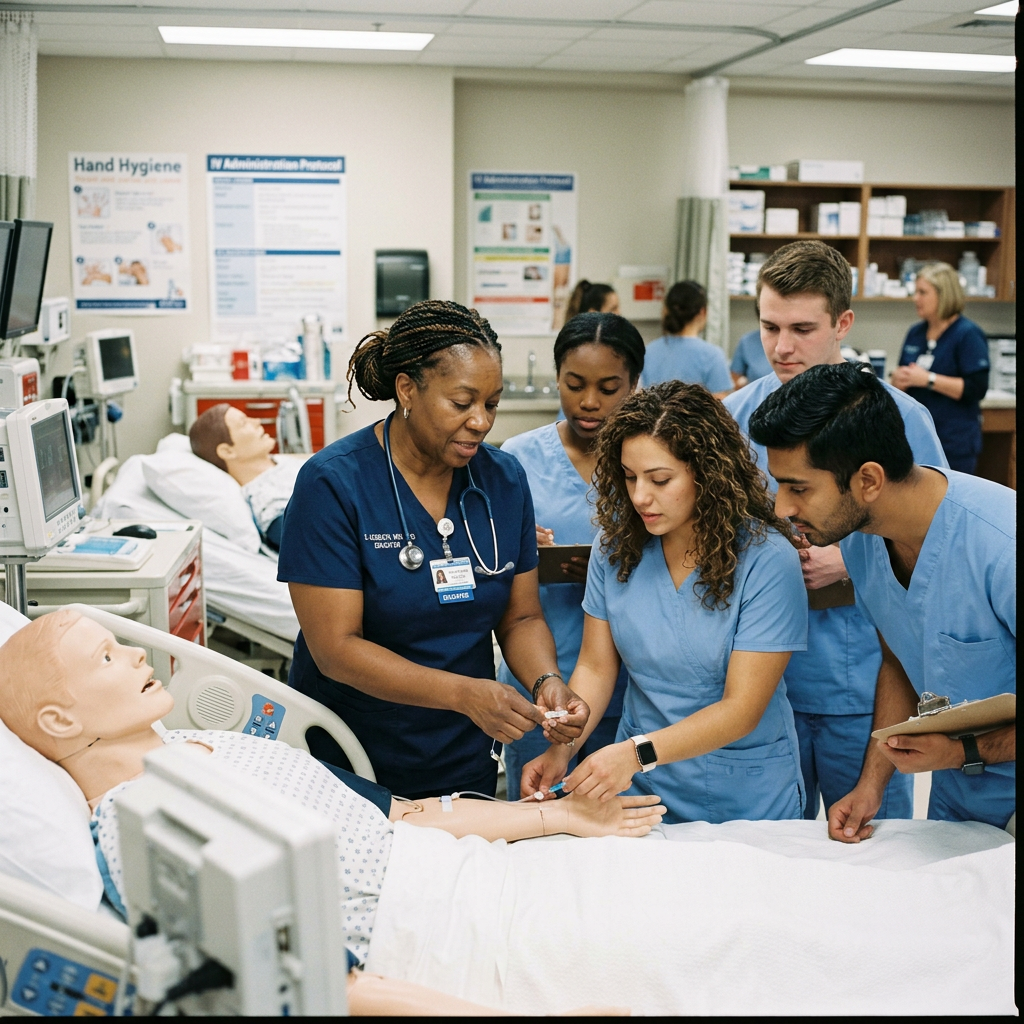
As the summer semester comes to an end, I find myself reflecting on how much I have learned. Not only about my students and clinical instruction; also about myself.
When I stepped into the role of nursing faculty, I knew I would be responsible for helping students connect what they had learned in the classroom to what they would experience at the bedside. I expected to review assessments, medications, clinical judgment, prioritization, communication, and safe nursing care. I did not fully anticipate how much this experience would teach me.
I have two more weeks of clinical remaining before the conclusion of the semester. Across four clinical groups, I have received positive feedback from my students. Their encouragement has meant more to me than they probably realize. I am reassured that they feel supported, the learning environment is meaningful, and my desire to help them grow was evident.
Still, the teacher in me knows there is more work to do, which means the student in me knows there is much more to learn.
A Different Perspective
Throughout this semester, I gained a deeper understanding of why some nursing students arrive on the clinical floor feeling unprepared. It is a trend that most nurse leaders have an opinion about. It is easy to look at a struggling student and assume they did not study enough, are not taking the experience seriously, or simply are not ready. Sometimes those concerns may be valid. But preparation is more complicated than memorizing information or passing an exam, and inefficient processes can prevent anyone from going from good to great.
Seeing the gaps up close has changed how I think about nursing education. It has made me ask better questions.
What do students truly need in order to become safe nurses?
How do we help them move beyond memorization and into clinical judgment?
How do we prepare them not only to pass their current course, but to pass the NCLEX on their first attempt?
How do we help them secure their first nursing position and enter that role with a realistic understanding of what transition to practice will require?
Passing the class matters.
Passing the NCLEX matters.
Getting the job matters.
But being prepared to care for real people when the safety net becomes smaller matters too.
It’s Not Just About the Next Test
This experience has strengthened my belief that nursing education cannot focus only on the next exam. The exam is important, but it is not the final destination.
Students need help understanding how the information they are learning will follow them into clinical practice. They need opportunities to connect the dots, ask questions without feeling ashamed, make mistakes in a safe environment, and receive correction that helps them improve rather than causes them to shut down.
They need structure.
They need clear expectations.
They need accountability.
They also need someone willing to recognize that struggling does not always mean incapable.
Sometimes it means the foundation needs to be strengthened.
Sometimes it means the material needs to be explained differently.
Sometimes it means the student needs help believing that growth is still possible.
As for myself, I am learning how to serve students more intentionally. These are not lessons to master in one semester.
Remaining Teachable
Proverbs 1:5 says, “Let the wise listen and add to their learning.”
I love the reminder within that verse. Wisdom does not mean we have reached the point where there is nothing left to learn. Wisdom recognizes how much there is still to understand. I may be the instructor in the clinical setting, but I am still a student of academia. I am learning the culture of nursing education. I am learning how today’s students process information. I am learning how to translate years of nursing experience into lessons that are clear, practical, and useful to someone who has not yet developed the instincts that experience brings.
I am learning that knowing how to do something and knowing how to teach it are not always the same skill.
That realization has been humbling. It has also been motivating.
James 1:5 reminds us that when we lack wisdom, we can ask God, who gives generously. I have found myself doing exactly that; asking for wisdom to recognize what my students need, wisdom to communicate in a way they can receive, and wisdom to know how to prepare them for a profession that will demand both competence and courage.
Mentorship is Mandatory
Perhaps the greatest lesson of this semester is that my role cannot end with clinical paperwork, evaluation forms, or final grades. The experience is strengthening my resolve to mentor those who cross my path and need support. Not every student will need the same thing from me.
Some may need clarification.
Some may need confidence.
Some may need correction.
Some may need someone to challenge the limits they have placed on themselves.
Some may simply need one person to see their potential before they are able to see it for themselves.
Second Timothy 2:2 speaks about entrusting what we have learned to faithful people who will be able to teach others also. That verse reminds me that what we pour into others does not stop with them. The knowledge, encouragement, expectations, and example we give can continue through every patient they care for and every nurse they may one day mentor.
There is still more for me to learn about academia. There is still more for me to understand about curriculum, student development, clinical judgment, NCLEX preparation, and transition to practice. There are still better ways for me to teach and students I have not yet met who may need what I am currently learning.
So, as this semester closes, I am not simply walking away as the teacher who completed her current assignment. I am walking away…
More aware.
More intentional.
More committed.
And even more certain than before that teaching and mentorship are part of how I am called to serve.
The teacher is still the student.
And perhaps the best teachers always are.